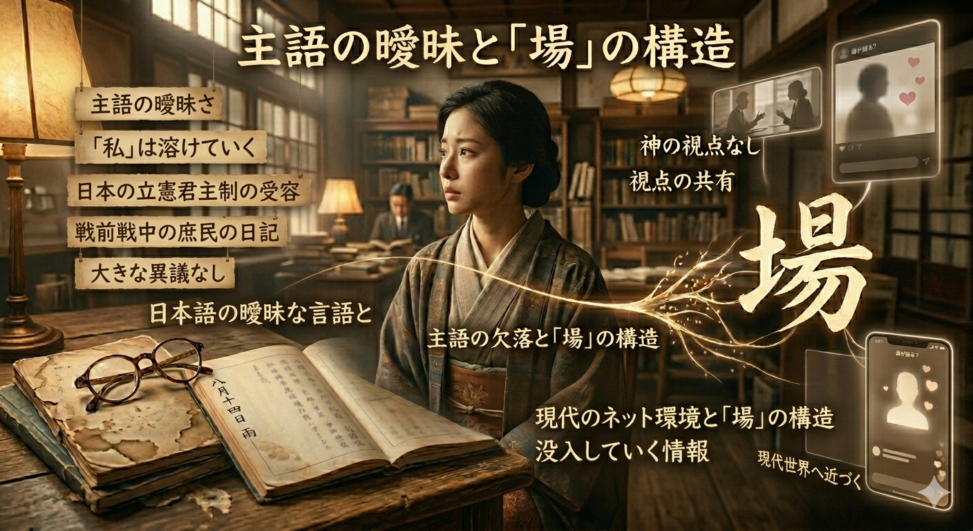
私は若い頃から、日本語には主語がない、あるいは主語を明示しなくても成立してしまうことに違和感を持ってきた。その違和感は、単なる言語の特徴ではなく、日本の社会や政治のあり方とどこかでつながっているのではないか、という感覚として残っている。
20代の頃、私は政治学を学びながら、近代日本のあり方について考えていた。そのとき浮かんだのは、日本語の構造が、人々の思考や受容の仕方に影響を与えているのではないか、という仮説だった。
入院生活のなかで読んだ戦前・戦中の庶民の日記には、状況を冷静に見つめる記述が確かに存在していた。それにもかかわらず、大きな異議として現れることはなかった。このことをどう理解すればよいのか、長く考え続けている。
日本語の構造は、主体の所在を曖昧にし、関係性や全体性を優先する傾向を持つ。そのため、中心的存在を明示的に対立させるのではなく、全体の中に位置づけて受け入れるような構えと親和性を持ちやすい。
その延長線上に、天皇制という日本の立憲君主制は、日本語を話す人々にとって、受容しやすい言語環境のなかにあったのではないだろうか。
さらに考えてみると、日本語の特徴は主語の曖昧さだけではない。物語の場は、上から与えられるものではなく、書き手の内側にあり、読む側にもまた同様に形成される。その成立を支えているのは、日本語において長く共有されてきた、主語を明示せずとも意味が通じるという言語的な前提ではないだろうか。この前提があることで、私たちは個別の視点を超え、ある種共通した「見え方」の中で物語を経験している。
おそらく、ここでいう「場」は、日本語という言語環境の中に、あらかじめ広がっているものではないかと思う。それは、使われることで輪郭を持ち、私たちの認識や振る舞いの中に、意識されない共通性をにじませているように思える。
たとえば、主語が明示されないまま会話が成立する状況では、「誰が言ったか」よりも、その場の関係や文脈が意味を方向づける。このとき私たちは、個々の主体というよりも、すでに広がっている「場」の中で振る舞っている。
こうした「俯瞰なき空間」は、現代のネット環境、とりわけ動画やSNSの空間ともどこか似ている。そこでは、誰が語っているのかは曖昧で、全体を見渡す視点は与えられず、人は断片的な情報の中に没入していく。
もしそうであるならば、日本語的な構造は、日本固有のものというよりも、むしろ現代の世界が近づきつつあるひとつのあり方なのかもしれない。
この仮説については、もう少し時間をかけて、言葉を探しながら考え続けていきたい。
■以下は、AIによる翻訳です。The following is a translation by AI.
Languages of Ambiguous Subjects and Space Without a Transcendent Perspective: A Hypothesis on Japanese-esque Space
Since my youth, I have felt a sense of unease regarding how the Japanese language lacks a clear subject, or rather, functions perfectly without specifying one. This discomfort remains with me, not merely as a linguistic quirk, but as a persistent feeling that it is somehow connected to the very nature of Japanese society and politics.
In my twenties, while studying political science, I reflected on the state of modern Japan. A hypothesis emerged: could the very structure of the Japanese language be influencing how people think and perceive the world? In the diaries of ordinary people from the pre-war and wartime eras, which I read during a period of hospitalization, there were indeed descriptions that looked at their circumstances with cold composure. Nevertheless, these never manifested as a major dissent. I have long contemplated how to understand this.
The structure of Japanese tends to obscure the location of the “subject” and prioritize relationships and totality. For this reason, instead of explicitly pitting a central entity against another, it has an affinity for a stance that positions and accepts everything within a whole. As an extension of this, perhaps the Emperor system, Japan’s constitutional monarchy, existed within a linguistic environment that was inherently easy to accept for those who speak Japanese.
Furthermore, the characteristics of Japanese are not limited to the ambiguity of the subject. The “place” (ba) where a story unfolds is not something given from above; it exists within the writer and is similarly formed within the reader. What supports this formation, perhaps, is the linguistic premise long shared in Japanese: that meaning is conveyed even without an explicit subject. Because of this premise, we experience stories within a certain shared “way of seeing” that transcends individual perspectives.
I suspect that the “field” or “space” (ba) mentioned here is something that already stretches out within the linguistic environment of the Japanese language. It seems to take shape through use, allowing an unconscious commonality to seep into our perceptions and behaviors. For instance, in a conversation where the subject remains unstated, the relationships and context of the “field” direct the meaning more than “who said it.” In such moments, we act not so much as individual subjects, but as participants within an already expanded “field.”
This “space without an overview” bears a resemblance to today’s digital landscape, particularly the spaces of video content and social media. There, who is speaking remains ambiguous, a bird’s-eye view is never granted, and people become immersed in fragmentary information. If this is the case, then the Japanese-esque structure may not be something unique to Japan, but rather a state of being that the modern world is increasingly approaching. I intend to keep searching for the right words and continue reflecting on this hypothesis.
コメントは受け付けていません。